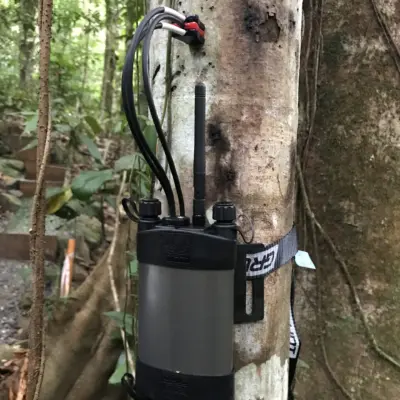
SDI 12 Sap Flow Sensor (SFS)
SDI-12 Sap Flow Sensor for real-time and continuous measurement of plant water use
Page Contents
From data to decisions
By quantifying plant water use, the SDI-12 Sap Flow Sensor supports:- Smarter irrigation scheduling and water budgeting
- Species selection and crop optimisation
- Climate and eco-physiological research
- Forest water use and carbon studies
Why This Sensor is Different
As part of the ICT International Sap Flow range, the SFS uses the Heat Ratio Method (HRM), Full details of the Heat Ratio Method can be found in Burgess, Adams, Turner, Beverly, Ong, Khan, & Bleby (2001). The Sap Flow Sensor brings a versatile and adaptable SDI-12 sensor using HRM to the product line, with key advantages over other SDI-12 or analogue measurement techniques:Data handling and processing
- SDI-12 Output: using SDI-12 V1.4 compatible commands, the SFS can be connected to many dataloggers, nodes, , or other SDI-12 systems.
- Onboard processing allows the SFS to provide actionable data directly, with no further processing required, when metadata is included
- IoT integration: Sap velocity data is optimised for transmission via LoRaWAN packets (node dependent), allowing for integration into IoT solutions
Construction and measurements
- Uniform construction of probes: An ISO9001:2015 certified company, ICT International implements robust production management processes that ensure that every probe is constructed in the same way, with the thermistors placed in the same location every time
- Constant current for the heater: The SFS features an advanced heater control circuit that detects the heater length and adjusts the energy delivered to the probe, ensuring the same heat pulse is emitted.
Probes
- Quick connect probes: Simplifies the installation as the probe can be inserted and then connected to the sensor body. Options include extension cables for installation of the sensor body further away.
- Interchangeable: Allowing customisation of the measurement solution to meet the plant anatomy, different probe lengths (12 mm, 22.5 mm, or 35 mm) are available.

When to use the SFS and when to choose the SFMx?
With the introduction of the Sap Flow Sensor, the ICT International range of sap flow measurement solutions now covers:
- SFS SDI-12: Sensor for connection to a data logger, controller or IoT node
- SFMxC or SFMx LoRaWAN: Device for direct connection as an IoT device (data transmitted through LoRaWAN or Cellular)
- SFMx: Standalone device with integral power management, calculations, and data logging
Each of these have different applications, and when combined with the water use calculation workflow, provide actionable insights from the collected data.
Designed for Easy Integration and calculations
- The sensor outputs via SDI-12 (v1.4), making it compatible with a wide range of dataloggers, controllers and IoT systems.
- Connect into existing SDI-12 networks or dataloggers
- Compatible with Campbell Scientific CR1000, CR1000X, and CR350 (with available scripts and manuals)
- Can be connected to any SDI-12 logger, LoRaWAN or Cat-M1 / NB-IoT nodes, or controllers that can support the SDI-12 protocol
- Ideal for remote and automated deployments
- Low-power consumption
Designed for IoT systems in agriculture, forestry, and environmental monitoring
- Onboard edge processing of data: Fully calculated data (corrected sap velocity in cm per hour) using plant meta data can be transmitted from the node, optimised to work with LoRaWAN packet sizes. Alternatively, uncorrected sap velocity can be transmitted to be combined with the meta data for processing at the database level.
- Calculations: Full scripts are available for the calculation of plant water use in litres on an hourly or daily (cumulative) basis to be displayed in visualisation and decision-making platforms
- Flexible probe configuration: Using M8 connectors, the probes can be exchanged to suit the application:
- 35 mm – suitable for woody stems
- 22.5 mm – suitable for both woody and herbaceous stems
- 12 mm – suitable for herbaceous stems with diameters up to 10 mm
These probes all have outer and inner measurement points. For more information, please check the Probe Lengths Options document.
Designed for Research
The onboard processor allows the user to choose outputs between calculated sap velocity values for immediate use and raw temperature data for post-processing. Configured at the datalogger/node, the SFS is designed to operate in one of two modes:
- Using standard SDI-12 Commands to retrieve:
- Uncorrected Inner Heat Pulse Velocity
- Corrected Outer Heat Pulse Velocity
- Corrected Inner Heat Pulse Velocity
- Corrected Outer Sap Velocity
- Corrected Inner Sap Velocity
- Using the Large Volume Command to record raw temperatures
The Raw temperature mode is ideal for research applications where post-processing of the data for algorithm development or comparison of measurement techniques. N.B. This can only be used in conjunction with a datalogger due to the large volume of data collected.
Specifications
| Voltage Input | 9-24 V |
| Maximum Current at 12V | 50 mA |
| Power Consumption | 2.635 Wh/day for a 10-minute measurement cycle at 12V. If using concurrent mode, SFS needs to be powered for 156 seconds (measurement time) + 90 seconds (supercapacitor charge time) If using measurement mode, SFS needs to be powered for 383 seconds (includes measurement and supercapacitor charge time) |
| Minimum Measurement Interval | 10 minutes (recommended) |
| Communication Interface | SDI-12 |
| Measurement Accuracy | 0.5 cm/hr |
| Measurement Resolution | 0.01 cm/hr |
| Enclosure Dimensions | 150 x 100 x 75 mm (L x W x H) |
Product Support
Case Studies
-
No case studies found