
Fire Weather Station
Page Contents
- Wind
- Temperature
- Solar radiation
- Precipitation (rain, snow, or dew)
- Drought
| Parameter | Tier 1 (Good) Indicative / Observation | Tier 2 (Better) Decision | Tier 3 (Best) Research / Benchmark |
| Temp/Humidity 2m | Vaisala HMP60 | Vaisala HMP110 | Vaisala HMP155 |
| Temp/Humidity 10m | Vaisala HMP60 | Vaisala HMP110 | Vaisala HMP155 |
| Wind 2m | Calypso | Windsonic | Windsonic 75 |
| Wind 10m | Calypso | Windsonic | Windsonic 75 |
| Barometer | SMB-110 | Vaisala PTB110 | Vaisala PTB210 |
| Rain | PRP-02 | RIM-7499-STD | RIM-7499-BOM |
| NDVI | SP411/412 | SP411/412 | |
| Fuel Load | CS506 | ||
| Dew Point (2nd Temp/humid sensor) | Vaisala HMP60 | Vaisala HMP110 | Vaisala HMP155 |
| Pyranometer | SP-421 | SP-421 | SP-421 |
| Soil Moisture | SMT-100 | TDR-310/315 | TDR-310/315 |
| Power System | |||
| Part Number | FWS-T1 | FWS-T2 | FWS-T3 |


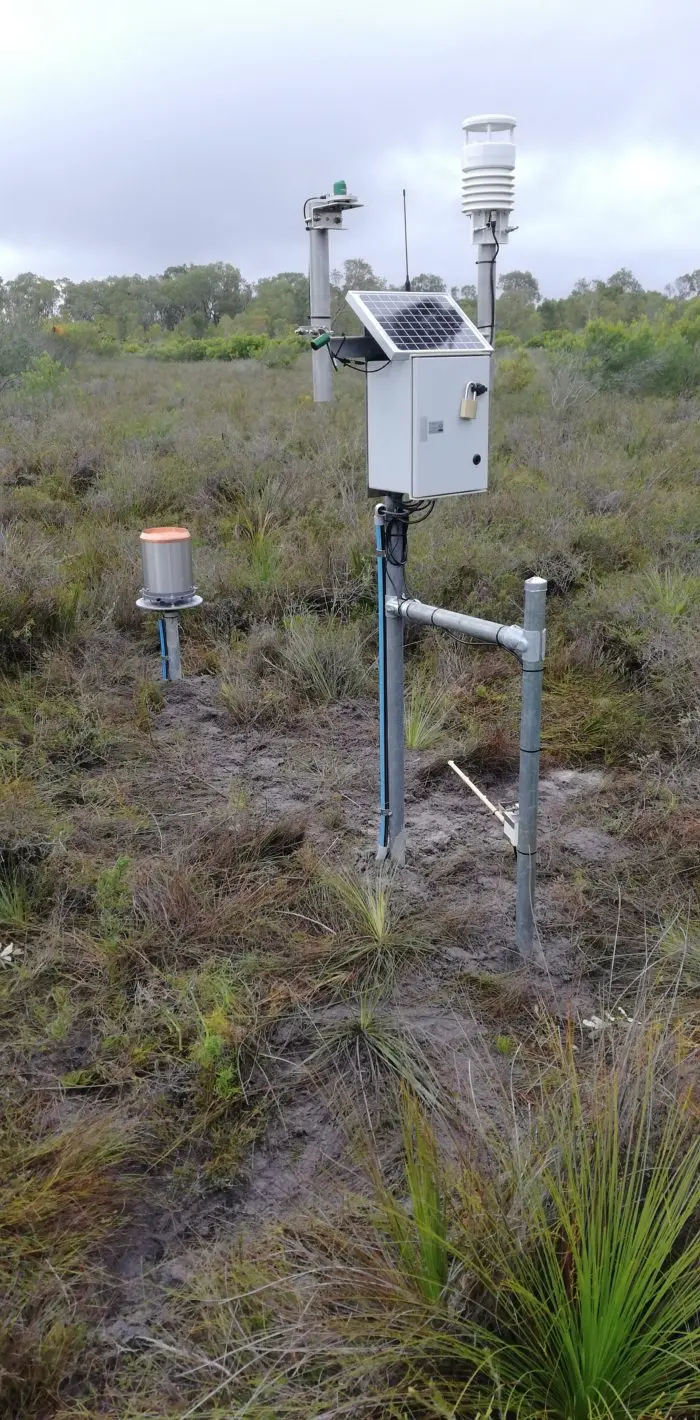
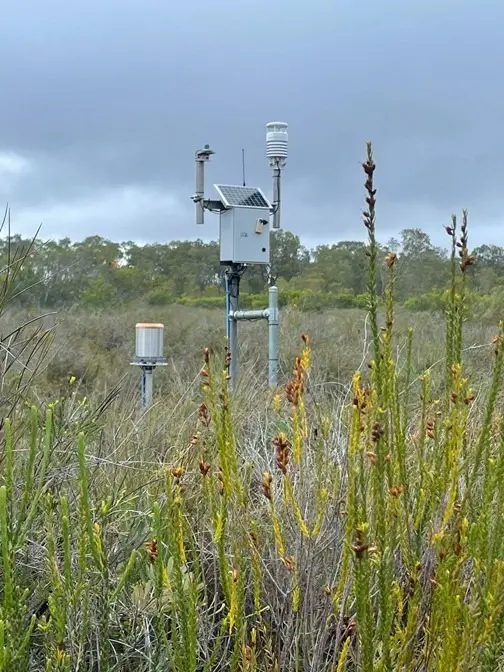
All systems are built upon the ICT International Datalogger, which is optimised for the online Dataview data handling platform. Providing an all-in-one datalogger, with power management and data handling, the datalogger platform is expandable with optional communication and sensor expansion modules.
The systems contain all parts required for the installation of the system, enabling the deployment of the system from the box. The sensors are pre-installed on the crossarm, and the RIM-7499-STD or RIM-7499-BOM include the stand to raise the rain gauge above the surrounding area.
Data
The Weather Station measures the following parameters which can be visualised in the online Dataview platform:
| Part Number | FWS-T1 | FWS-T2 | FWS-T3 |
| Temp/Humidity | Direct measure: Temperature HumidityCalculated: Wet Bulb Temperature Dew point VPD |
Direct measure: Temperature HumidityCalculated: Wet Bulb Temperature Dew point VPD |
Direct measure: Temperature HumidityCalculated: Wet Bulb Temperature Dew point VPD |
| Wind | Wind speed, wind direction and gusts | Wind speed, wind direction and gusts | Wind speed, wind direction and gusts |
| Rain | Daily rainfall (user defined time – default to 9am)
Visualisations: |
Daily rainfall (user defined time – default to 9am)
Visualisations: |
Daily rainfall (user defined time – default to 9am)
Visualisations: |
| Pyranometer | Solar Radiation in watts per square metre | Solar Radiation in watts per square metre | Solar Radiation in watts per square metre |
| Geolocation | Accurate to 5 decimal places (approximately 1.11 metres, depending on installation conditions) | Accurate to 5 decimal places (approximately 1.11 metres, depending on installation conditions) | Accurate to 5 decimal places (approximately 1.11 metres, depending on installation conditions) |
Furthermore, these values can be used to calculate the evapotranspiration rate using the Penmen-Monteith FAO56 equation. Evapotranspiration is a key measurement when understanding the water relationship in the agricultural or natural environment, and can be used to understand water requirements, along with the rate of plant water use for fire risk assessment and management
About the Sensors
Tier 1 Sensors (FWSM-T1)
Ideal for installations where measurement locations may change frequently (such as harvest risk management), the FWSM-T1 Fire Weather Station is mounted to the ICT International cross arm, ready to be installed (once the sensors are orientated to the north/equator as required). Requiring minimal installation infrastructure, the FWSM-T1 is designed for repeatable measurements in many locations.
The use of reliable and proven technologies makes the ideal solution for widespread networks across a study site. Designed for ease of installation with the crossarm, the Tier 1 sensors are a compact system that provides quality data for fire risk calculations.
- Temperature/Humidity (Vaisala HMP60): For the measurement of vapour pressure deficit (VPD), a reliable, robust, and proven sensors is essential. The Vaisala HMP range of temperature and humidity sensors utilise a replaceable calibration chip that ensures high quality data is collected for the calculation of VPD – the atmospheric driver within the soil, plant, atmosphere continuum and a key parameter in the calculation of Evapotranspiration. The temperature/humidity sensor includes a matt radiation shield to reduce reflection, ensuring that there is minimal measurement interference.
- Wind (Calypso): A compact ultrasonic wind speed and direction sensor, the Calypso wind sensor measures gusts, direction, and speed at a user defined frequency. With no moving parts, the Calypso wind sensor is ideal for measurement and monitoring applications.
With a compact profile, the Calypso has minimal installation effects on other sensors. - Rain (PRP-02): A robust tipping bucket rain gauge with 0.2 mm resolution, the PRP-02 is mounted on the crossarm, alongside the other sensors ensuring the station is easy to install and transport.
- Pyranometer (SP-421): With traceability to ISO9060, the Apogee SP-421 is a proven, reliable, calibrated pyranometer for the measurement of solar radiation. Ideal for shortwave radiation measurement in agricultural, ecological, and hydrological weather networks, the SP-421 is essential in the calculation of FAO Evapotranspiration models.
- Power System: Supplied with the High Power system containing a 20-watt solar panel and matching mount, and an internal 13,000mAh battery. The power system can be expanded with a supplementary 20-watt solar panel and mount to provide additional charge when used in low light conditions (EP-H).
Tier 2 Sensors (FWSM-T2)
The Tier 2 sensors are ideal for long-term installation; the rain gauge is set above the ground using the included stand, whilst the other sensors can be mounted to a tripod or pole using the included crossarm.
- Temperature/Humidity (Vaisala HMP110): Vaisala HMP110: The HMP110 builds upon the benefits of the HMP60, but is a higher accuracy for both humidity (±1.5 %RH vs ±3 %RH) and temperature (±0.1 °C vs ±0.5 °C). The temperature/humidity sensor includes a matt radiation shield to reduce reflection, ensuring that there is minimal measurement interference.
- Wind (Windsonic): A high-performance ultrasonic anemometer, for use in measuring up to 60m/s (26km/h) wind speeds. With no moving parts, ultrasonic anemometers are ideal for installation where access may be difficult, providing low ongoing costs and reliable data. The Windsonic is a low power solution that still provides high quality data for decision making and monitoring.
- Rain (RIM-7499-STD): Stainless steel shell, copper collector, and brass tipping bucket, the RIM-7499 rain gauges are designed for long-term installations that require high quality rainfall data. With the included stand, the RIM-7499 rain gauge can be mounted above the ground to avoid ground-based debris blowing into the collector.
- Pyranometer (SP-421): With traceability to ISO9060, the Apogee SP-421 is a proven, reliable, calibrated pyranometer for the measurement of solar radiation. Ideal for shortwave radiation measurement in agricultural, ecological, and hydrological weather networks, the SP-421 is essential in the calculation of FAO Evapotranspiration models.
- NDVI Apogee SP-411/412: A pair of sensors that calculate the NDVI by measuring the incoming and reflected radiated Red and Near Infrared (NIR) light provided by green foliage. Green foliage represents well hydrated, healthy trees and plants, and this will have sufficient water to supply them. When the plant is under stress, the green (chlorophyll content of leaves) falls, leaving a leaf that reflects more red light. As plants become stressed, red-light reflection increases as the photosynthetic system becomes less efficient and a decreased near infrared reflection as the cells become less turgid due to water stress.
- Power System: Supplied with the Low Power system containing a 10-watt solar panel and matching mount, and an internal 6,000mAh battery. The power system can be expanded with a supplementary 10-watt solar panel and mount to provide additional charge when used in low light conditions (EP-L).
Tier 3 Sensors (FWSM-T3)
The Tier 3 sensors provide a high-quality research platform for detailed measurement of the hydrological flux. Integrating a highly responsive and accurate temperature humidity sensor, wide measurement range of wind speed (up to 75 metres/second), and a national standard rain gauge, the tier 3 sensor suite provides the benchmark system for researchers to build their experiments and models around.
- Temperature/Humidity (Vaisala HMP155): Vaisala HMP155: The HMP155 provides a highly accurate, traceable, temperature and humidity probe for leading research applications. Individually adjusted and calibrated using a six-point calibration across humidity ranges from completely dry to near saturated, the HMP155 is the temperature and humidity sensor for high quality measurements. The temperature/humidity sensor includes a matt radiation shield to reduce reflection, ensuring that there is minimal measurement interference.
- Wind (Windsonic 75): Measuring windspeeds up to 75m/s (270 km/h), the Windsonic 75 is a WMO standard (for wind gust measurement) solution for high quality data acquisition. With a higher resolution output for wind direction (0.1°) than the Windsonic, the Windsonic 75 will provide detailed data for analysis and model building.
- Rain (RIM-7499-BOM): Taking the core structure of the RIM-7499-STD but increasing the accuracy to meet the requirements of national meteorological organisations, the RIM-7499-BOM is a high-quality rain gauge that will provide accurate data for detailed decision making.
- Pyranometer (SP-421): With traceability to ISO9060, the Apogee SP-421 is a proven, reliable, calibrated pyranometer for the measurement of solar radiation. Ideal for shortwave radiation measurement in agricultural, ecological, and hydrological weather networks, the SP-421 is essential in the calculation of FAO Evapotranspiration models.
- NDVI Apogee SP-411/412: A pair of sensors that calculate the NDVI by measuring the incoming and reflected radiated Red and Near Infrared (NIR) light provided by green foliage. Green foliage represents well hydrated, healthy trees and plants, and this will have sufficient water to supply them. When the plant is under stress, the green (chlorophyll content of leaves) falls, leaving a leaf that reflects more red light. As plants become stressed, red-light reflection increases as the photosynthetic system becomes less efficient and a decreased near infrared reflection as the cells become less turgid due to water stress.
- The unique sensor included in the Tier 3 suite of sensors is the CS506 Fuel Load Sensor. Using a precision manufactured dowel and a highly accurate moisture sensor attached to the dowel, the Fuel Load Sensor provides an estimate of the 10-hour fuel load that is present at ground level. Recognised as a key parameter in fire risk and fuel load modelling, the fuel load is required in many models to provide accurate estimates (along with other influential parameters) of fuel dryness.
- Power System: Supplied with the Low Power system containing a 20-watt solar panel and matching mount, and an internal 13,000mAh battery. The power system can be expanded with a supplementary 10-watt solar panel and mount to provide additional charge when used in low light conditions (EP-H)
Sensor Specifications
<td style=”height: 30px;” w
| Parameter | Tier 1 (Good) Indicative / Observation |
Tier 2 (Better) Decision |
Tier 3 (Best) Research / Benchmark |
|||||||||||
| Part Number | FWS-T1 | FWS-T2 | FWS-T3 | |||||||||||
| Sensor | Range / Accuracy | Value | Sensor | Range / Accuracy | Value | Sensor | Range / Accuracy | Value | ||||||
| Temperature / Humidity | Vaisala HMP60 | Range (temp) | −40 … +60 °C | Vaisala HMP110 | Range (temp) | −40 … +80 °C | Vaisala HMP155 | Range (temp) | −80 … +60 °C | |||||
| Accuracy (temp) | +10 … +30 °C | ±0.5 °C | Accuracy (temp) | +15 … +25 °C | ±0.1 °C | Accuracy (temp) | At −80 … +20 °C | ±(0.176 – 0.0028 × temp) °C | ||||||
| at +10 … +30 °C | ±0.5 °C | 0 … +15 °C and +25 … +40 °C | ±0.15 °C | At +20 … +60 °C | ±(0.07 + 0.0025 × temp) °C | |||||||||
| −40 … 10 °C and +30 … +60 °C | ±0.6 °C | −40 … 0 °C and +40 … +80 °C | ±0.4 °C | |||||||||||
| Range (humidity) | 0–100 %RH | Range (humidity) | 0–100 %RH | Range (humidity) | 0–100 %RH | |||||||||
| Accuracy (humidity) | 0 … +40 °C | ±3 %RH (0–90 %RH)
±5 %RH (90–100 %RH) |
Accuracy (humidity) | 0 … +40 °C | ±1.5 %RH (0–90 %RH)
±2.5 %RH (90–100 %RH) |
Accuracy (humidity) | At +15 … +25 °C | ±1 %RH (0 … 90 %RH)
±1.7 %RH (90 … 100 %RH) |
||||||
| at −40 … 0 °C and +40 … +60 °C | ±5 %RH (0–90 %RH)
±7 %RH (90–100 %RH) |
at −40 … 0 °C and +40 … +80 °C | ±1.1 %RH (0–90 %RH)
±1.8 %RH (90–100 %RH) |
At −20 … +40 °C | ±(1.0 + 0.008 × reading) %RH | |||||||||
| At −40 … −20 °C | ±(1.2 + 0.012 × reading) %RH | |||||||||||||
| At +40 … +60 °C | ±(1.2 + 0.012 × reading) %RH | |||||||||||||
| At −60 … −40 °C | ±(1.4 + 0.032 × reading) %RH | |||||||||||||
| Replaceable Calibration Chip | Yes | Replaceable Calibration Chip | Yes | Replaceable Calibration Chip | Yes | |||||||||
| Wind | Calypso | Speed: Range | 0.5-45 m/s | Windsonic | Speed: Range | 0 – 60 m/s | Windsonic 75 | Speed: Range | 0 – 75 m/s | |||||
| Speed: Accuracy | ± 0.3 m/s up to 10m/s and 3% from 10 to 45m/s | Speed: Accuracy | 2% RMSE @12 m/s | Speed: Accuracy | 2% RMSE @12 m/s | |||||||||
| Speed: Resolution | 0.01 m/s | Speed: Resolution | 0.01 m/s | |||||||||||
| Direction: Range | 0-360º | Direction: Range | 0 – 360° (no dead band) | Direction: Range | 0 – 360° (no dead band) | |||||||||
| Direction: Accuracy | ± 1º | Direction: Accuracy | 2° RMSE @12 m/s | Direction: Accuracy | 2° RMSE @12 m/s | |||||||||
| Direction: Resolution | 1° | Direction: Resolution | 0.1° (at 0, 1 or 2
decimal places) |
|||||||||||
| Rain | PRP-02 | Collector Area | 200cm2 | RIM-7499-STD | Collector Diameter | 203 mm ± 0.2mm | RIM-7499-BOM | Collector Diameter | 203 mm ± 0.2mm | |||||
| Resolution | 0.2mm | Resolution | 0.2mm | Resolution | 0.2mm | |||||||||
| Accuracy | ±2%, to a maximum 144 mm/hr | Accuracy | ±3% to 250mm/hr
±4% from 251mm/hr to 350mm/hr |
Accuracy | ±2% to 250mm/hr
±4% from 250mm/hr to 350mm/hr |
|||||||||
| Materials: Collector | Acrylonitrile Styrene Acrylate | Materials | Collector | Copper | Materials | Collector | Copper | |||||||
| Bucket | Gold Plated Brass | Bucket | Gold Plated Brass | |||||||||||
| Jacket | Stainless Steel | Jacket | Stainless Steel | |||||||||||
| Base | Cast Marine Grade Aluminium | Base | Cast Marine Grade Aluminium | |||||||||||
| Pyranometer | SP-421 | Output Range | 0 to 2000 W mˉ² | SP-421 | Output Range | 0 to 2000 W mˉ² | SP-421 | Output Range | 0 to 2000 W mˉ² | |||||
| Calibration Uncertainty at 1000 W mˉ² | Less than 3% | Calibration Uncertainty at 1000 W mˉ² | Less than 3% | Calibration Uncertainty at 1000 W mˉ² | Less than 3% | |||||||||
| Non-stability (Long-term Drift) | Less than 2 % per yea | Non-stability (Long-term Drift) | Less than 2 % per yea | Non-stability (Long-term Drift) | Less than 2 % per yea | |||||||||
| Spectral Range | 360 to 1120 nm (wavelengths where response is 10 % of maximum) | Spectral Range | 360 to 1120 nm (wavelengths where response is 10 % of maximum) | Spectral Range | 360 to 1120 nm (wavelengths where response is 10 % of maximum) | |||||||||
| NDVI | S2-411-SS Upward | Wavelength Ranges: Red detector | 650 nm with 10 nm full-width half-maximum | S2-411-SS Upward | Wavelength Ranges: Red detector | 650 nm with 10 nm full-width half-maximum | ||||||||
| ± 3 nm | ± 3 nm | |||||||||||||
| Wavelength Ranges: NIR detector | 810 nm with 10 nm full-width half-maximum | Wavelength Ranges: NIR detector | 810 nm with 10 nm full-width half-maximum | |||||||||||
| ± 3 nm | ± 3 nm | |||||||||||||
| S2-412-SS Downward | Wavelength Ranges: Red detector | 650 nm with 10 nm full-width half-maximum | S2-412-SS Downward | Wavelength Ranges: Red detector | 650 nm with 10 nm full-width half-maximum | |||||||||
| ± 3 nm | ± 3 nm | |||||||||||||
| Wavelength Ranges: NIR detector | 810 nm with 10 nm full-width half-maximum | Wavelength Ranges: NIR detector | 810 nm with 10 nm full-width half-maximum | |||||||||||
| ± 3 nm | ± 3 nm | |||||||||||||
| Soil Moisture and Temperature | SMT-100 | Soil Temp | Range | -40 to +80°C | TDR315 /310 | Temperature | Range | -40 to +55 °C | TDR315 /310 | Temperature | Range | -40 to +55 °C | ||
| Resolution | 0.01°C or better | Resolution | 0.1°C | Resolution | 0.1°C | |||||||||
| Accuracy | Typical ± 0.2°C, max. ± 0.4°C over full range | Accuracy | + 5 to 35 °C
±0.25 °C – 15 to 55 °C ±0.5 °C |
Accuracy | + 5 to 35 °C
±0.25 °C – 15 to 55 °C ±0.5 °C |
|||||||||
| Soil Moisture | Range | 0 to 60% volumetric water content
(up to 100% limited accuracy) |
Moisture | Range | 0% to 100% VWC | Moisture | Range | 0% to 100% VWC | ||||||
| Accuracy | Up to ± 3% (VWC) from 0 to 50% VWC
Using specific calibration up to ± 1% |
Accuracy | ±2%FS | Accuracy | ±2%FS | |||||||||
| Resolution | 0.1% or better | Resolution | 0.1% | Resolution | 0.1% | |||||||||
Product Support
Case Studies
-
No case studies found